



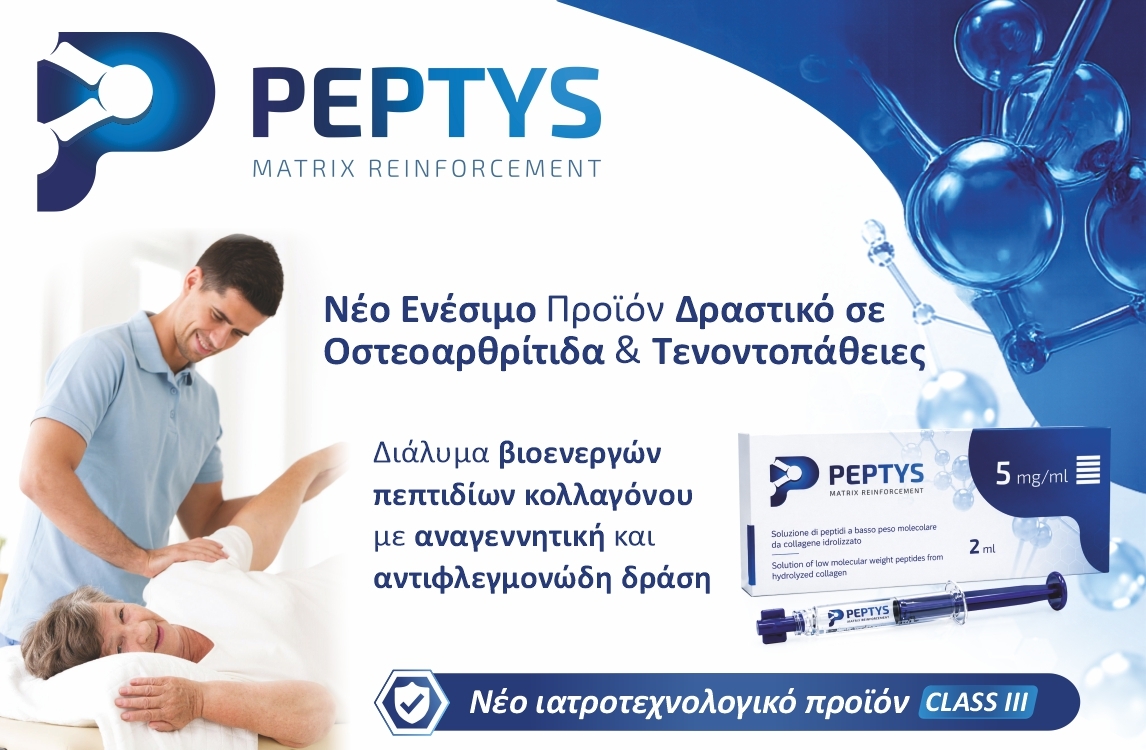
WHAT PEPTYS IS
Injectable solution based on low molecular weight peptides (LWPs) from hydrolyzed collagen for the reinforcement and structural renewal of the extra-cellular matrix of connective tissues.
This is Medical Device Class III.
INNOVATIVE FORMULATION OF PEPTYS
Qualitative formulation:
Collagen: low molecular weight peptides (LWPs) from bovine hydrolyzed collagen;
Excipients:
Vitamin C (MAP, magnesium-ascorbyl-phosphate) in low concentration; PBS (Phosphate-Buffered Solution).
Vitamin C thanks to its antioxidant power, protects LWPs during product sterilization via gamma rays.
THE CHOICE OF THE MAP
The choice of an antioxidant agent such as MAP (Magnesium Ascorbyl Phosphate) guarantees the product unique and truly innovative features as well as representing an important competitive advantage over other products with LWPs only or containing collagen.
PEPTYS while degrading releases small quantities of vitamin C and magnesium .
Vitamin C
Foundamental co-factor for collagen biosynthesis, it also exerts strong antioxidant action
Magnesium
Promotes cell adhesion and cartilage formation
DIFFERENCES FROM THE OTHER THERAPEUTIC OPTIONS
Innovative formula: the first MD with LWPs & MAP;
• ready to use LWPs solution;
• available in different concentrations and volumes;
• it acts on symptoms and stimulates tissues healing;
• wide spectrum of applications.
WHAT IS NEW WITH THIS TERAPEUTIC REGIMEN?
It is a very innovative medical device with effective “biologicalaction ”.
Its LWPs actively reinforce connective tissues, promoting their restoration
and renovation.
HOW IS PEPTYS DIFFERENT FROM TRADITIONAL COLLAGEN?
It is very different from traditional collagen:
It is not collagen, but a LWPs solution with a MW > 3kDa:
HIGH BIO-AVAILABILITY AND WIDE BIO-ACTIVITY
MW of the main ingredient is100 times smaller
The main ingredient is 40 times and 100times more concentrated
HOW DOES IT BENEFIT THE PATIENT?
Biological treatment
- no blood withdraw
- no surgery
Also HA non-responder patients can benefit
Quick relief from painful symptoms
Reduction of inflammation and general improvement of joint function
TREATMENTS:
The posology depends of course on the sole indication of the doctor.
Anyway on the basis of our experiences here our suggestions:
We generally suggest:
the 2 mg/ml concentration for intra-articular therapy in:
• Young patients (sometimes they just require 1 or 2 injections anyway);
• AO early stages;
• Athlets in case of fatigue or overload (even 1 injection only);
• For doctors who want to follow their patients time by time.
• the 5 mg/ml concentration for: • peri-articular and intra-tendinous treatments;
• Elderly patients;
• Severe OA stages;
• For doctors who want to minimize the number of injections/visits;
WHY COLLAGEN INSTEAD of HA or PRP
HA: bio-modulated MECHANICAL ACTION
It mainly acts as a lubricant and shock absorber.
PRP: BIOLOGICAL ACTIVITY
It mainly acts on cell receptors.
Is really “collagen” an alternative to HA and/or to PRP?
PEPTYS: BIOLOGICAL ACTIVITY
Interference with cell receptors and matrix reinforcement.
PEPTYS can be really an ALTERNATIVE:
HA non responder.
HA contraindications (chondrocalcinosis).
OA early stages.
In young and athletes due to trauma or overuse.
PEPTYS can be COMPLEMENTARY or SYNERGISTIC
When visco-supplementation is necessary.
Severe and/or advance OA.
To prolong, maintain or improve musculoskeletal comfort.
SYNERGISTIC USE OF PEPTYS AND HA/PRP
There is no know contraindications in using PEPTYS associated with
other substances.
HA + cortisone and HA + PRP are already in use.
In the past we had experiences with LWPs + PRP with very good clinical outcomes, but there are not available data showing these are better or more lasting than results with LWPs only.
Since PRP has some equivalent mechanism to PEPTYS, maybe the best synergistic use is together with HA, then improving the mechanical support of the synovial fluid while the biological activities of PEPTYS are in progress.
The most effective rationale in this case would be to inject the HA a couple of weeks after treatment/s.
PRP could be an option anyway, to enhance or trigger further biological activities after treatment with LWPs. Its action on MSCs could bring further benefits to the cartilage matrix.
PERI-ARTICULAR TREATMENT: THE GOALS
Promoting and speed up healing after injuries/surgeries;
Reducing pain and inflammation;
Increasing strength of tendons and ligaments;
Stimulating connective tissue matrix reinforcement;
Reducing risk of injuries;
Improving mobility.
MECHANISM OF ACTION OF LWPs
LWPs surely represent an optimal substrate for the action of cell components involved in the regulation of connective tissue homeostasis.
LWPs provide specific amino acid sequencesof the collagen structure at the injection site, useful for the structural reinforcement and functional recovery of joints and periarticular structures.
LWPs contribute to collagen fibers remodeling.
LWPs naturally carry out a negative regulation of lytic enzymesleading to a significant reduction of inflammation.
PERI-ARTICULAR TREATMENT: SOME NUMBERS
The incidence of tendinopathies is growing due to greater participation in sports.
About 30% of runners go against Achilles tendinopathy with an annual incidence between 7 and 9%.
Patellar tendinopathy is very common in the sport of volleyball (13%), handball athletes (13%), basketball (12%) and soccer players (2.5%)
Medial elbow tendinopathy is between 0.8% and 29.3%.
40-50% of tennis players have at least one episode a year of tennis elbow.
PERI-ARTICULAR TREATMENT: INDICATIONS
Tendinopathies are of course the main indications of peri-articular treatment.
The causes of tendinopathies are trauma, functional, systemic and degenerative diseases:
TRAUMAS OVERLOAD SYSTEMIC DEGENERATIVE
PERI-ARTICULAR TREATMENT: INDICATIONS
Tennis elbow
Golfer's elbow
Jumper's knee
Thrower's shoulder
Enthesitis-tendinitis and tendinosis:
Yarrow enthesitis;
Plantar fasciitis;
Epicondylitis,
Epitrocleitis;
Patellar enthesitis;
Shoulder tendinitis/tendinosis.
PERI-ARTICULAR TREATMENT: BODY SITES
Achilles tendon;
Plantar fascia;
Peroneal tendons;
Patellar tendon;
Quadriceps tendon;
Elbow extensor tendons;
Rotator cuff.
TENDINOPHATIES: COMMON TREATMENTS
Ice and rest;
Massages;
Physiotherapy;
Tecar, laser therapy;
Shock waves;
PRP injections;
NSAIDs and cortisone injections;
Surgery.
PERI-ARTICULAR TREATMENT: GENERAL TECHNIQUE
Tendinopathies can be treated with peritendinous and intra-tendinous PEPTYS injections under ultrasound guidance.
PEPTYS can be distributed part under the tendon sheath close to the lesion/inflammation area, part outside the sheath in the area surrounding the
injury/inflammation.(Peritendinous use suggested)
Use a needle of 26-28 G with a length of about 40 mm inserted at 90°.
SHOULDER AND ROTATOR CUFF
1) Posterolateral approach: subacromial injection in the small space between bony acromion that sits on top of the shoulder and the humeral head. A long 18 gauge needle
should 2-3cm anterior to the posterolateral corner of the acromion.
2) Posterior approach: glenohumeral joint injection. The needle is inserted 2-3 cm inferior
and medial to the posterolateral corner of the acromion and directed anteriorly towards the
coracoid process
3) Anterosuperior approach: acromioclavicular joint injection. The distal aspect of the clavicle is palpated to identify the convexity of the AC joint where the clavicle meets the acromion, then the needle is inserted from an anterior and superior angle and directed inferiorly.
Intra-articular injections of PEPTYS 2.
Use a 23-28 G needle with a length of about 50 mm
SHOULDER AND ROTATOR CUFF
1) With a lateral or posterolateral approach, insert the needle in the subacromial space
2) Insert the needle in the center of the segment that ideally goes from the acromioclavicular joint to the top of the anterior axillary fold.
3) Insert the needle into the dimple of the posterior aspect of the shoulder joint along the vertical line passing from the posterior axillary fold.
4) Insert the needle into the posterolateral dimple that forms between the acromion and the greater humeral tubercle.
Peri-articular injections of PEPTYS 5.
Use a 26-28 G needle with a length of about 40 mm
EPICONDYLITIS TREATMENT
1) With the elbow flexed at 90°,insert the needle towards the epicondyle
2) Insert the needle at the tip of the flexed elbow at 90°
3) With the elbow flexed at 90°, insert the needle about 3-4 cm distal to point 2
Intra-tendinous/intra-muscular injections of PEPTYS 5.
Use a 26-28 G needle with a length of about 16 mm.
Enter at 90° at a depth of 5-6 mm.
EPITROCLEITIS TREATMENT
1) Insert the needle between the trochlea and the olecranon on the medial site of the elbow flexed at 90°
2) Insert the needle in the meddle of the elbow crease inside the distal biceps tendon.
Intra-tendinous/intra-muscular injections of PEPTYS 5.
Use a 26-28 G needle with a length of about 16 mm.
Enter at 90° at a depth of 5-6 mm.
YARROW (ACHILLES) TENDINOPATHY
1) Under ultrasound guidance insert the needle under the peritenon in proximity of the inflammation/lesion area. Release part of the solution just outside the tendon.
Intra-tendinous injections of PEPTYS 5.
Use a 26-28 G needle with a length of about 40 mm.
Enter along the tendon direction at 30°. 45° at a depth of 5-6 mm.
PERONAL TENDONITIS
1) Under ultrasound guidance insert the needle in the longitudinal plane of the transducer from an anterior and inferior to posterior and superior direction under the peritenon into the space between the two tendons.
Intra-tendinous injections of PEPTYS 5.
Use a 26-28 G needle with a length of about 40 mm.
Enter along the tendon direction at 30° at a depth of 5-6 mm.
PLANTARIS FASCITIS
1) Insert the needle in line with the posterior edge of the medial malleolus one finger breadth above the sole. Avoid to inject through the base of the foot, because this approach can result in fat pad atrophy.
Intra-tendinous injections of PEPTYS 5.
Use a 26-28 G needle with a length of about 40 mm.
Enter at 90° at a depth of 20-25 mm.
PATELLAR TENDINOPATHY: THE JUMPER’S KNEE
With the knee relaxed and slightly flexed, under ultrasound guidance, insert the needle under the peritenon near the inflamed area. Release part of the product also outside the tendon.
Intra-tendinous / subcutaneous injections of PEPTYS 5. Use a 26-28 G needle with a length of about 30-40 mm. Enter at 45°.
FOR CLINICAL EVIDENCE ON LWPs OF PEPTYS SEND US AN INQUIRY AT This email address is being protected from spambots. You need JavaScript enabled to view it.